
The history of cinema is one that has never stopped being written since it began over 100 years ago, and at Brainstorming Films we will tell you everything. Surely those first to enter this industry imagined it would evolve, but not to this extent. Nowadays, movies are one of the most important forms of entertainment.
How did it all begin? What contributed to its evolution? Let's see!
Beginnings of the history of cinema
The history of cinema began in the year 1895, exactly on December 28 in a hall on the Boulevard des Capucines, Paris. The men responsible for starring in this important episode of the film industry were August and Louis Lumière.
The brothers presented the Lumière Cinématographe, an invention from which moving images were transmitted. At the event on December 28, a short film was presented that had a duration of less than one minute and was titled “Leaving the Lumière Factory.”
The black and white short film, silent, shows the door of the Lumière brothers' factory. There, men and women can be seen exiting the building at the end of their workday. Although today it is a simple recording, in 1895 it was an entire innovation.
If you are interested in learning more about the first movie in history, you can learn more about this fact in the following article.
Reactions to the first moving images in the history of cinema
The event in which “Leaving the Lumière Factory” was presented was promoted with posters throughout the city. However, only a little more than 30 people attended and, as strange as it may seem, there is no record of that, as the Lumières were very busy with the presentation.
Despite the low attendance, what happened in that hall quickly became known throughout Paris. The popularity of the brothers August and Louis increased, as they were already known (even outside their country) for their inventions that contributed to static photography.
From that moment on, the Lumières would make history in the film industry, evidenced by the fact that they are considered the fathers of the cinematograph.
Did anything similar to cinema exist before 1895?
Cinema did not emerge suddenly; to reach the cinematograph, it was necessary to create other elements that led to moving images. One of the most notable was the Magic Lantern, whose main objective was to entertain children. It rotated images quickly enough to simulate movement.
The origin of the Magic Lantern dates back to the 16th century, and in the 18th century, a device called Phantasmagoria was introduced. It projected images painted on glass plates. In the years that followed, other inventions emerged until photography was invented in 1874.
It didn't take long for people to start looking for ways to make images move. Eadweard Muybridge managed to reproduce a galloping horse through photographs.
Additionally, we leave you this article about the beginning of cinema where you can learn more extensively about the beginning of cinema.
The influence of Georges Méliès
One of the pioneers in the film industry is Georges Méliès, who is called “The magician of cinema”. He invested in Lumière technology, aiming to make films more realistic and natural.
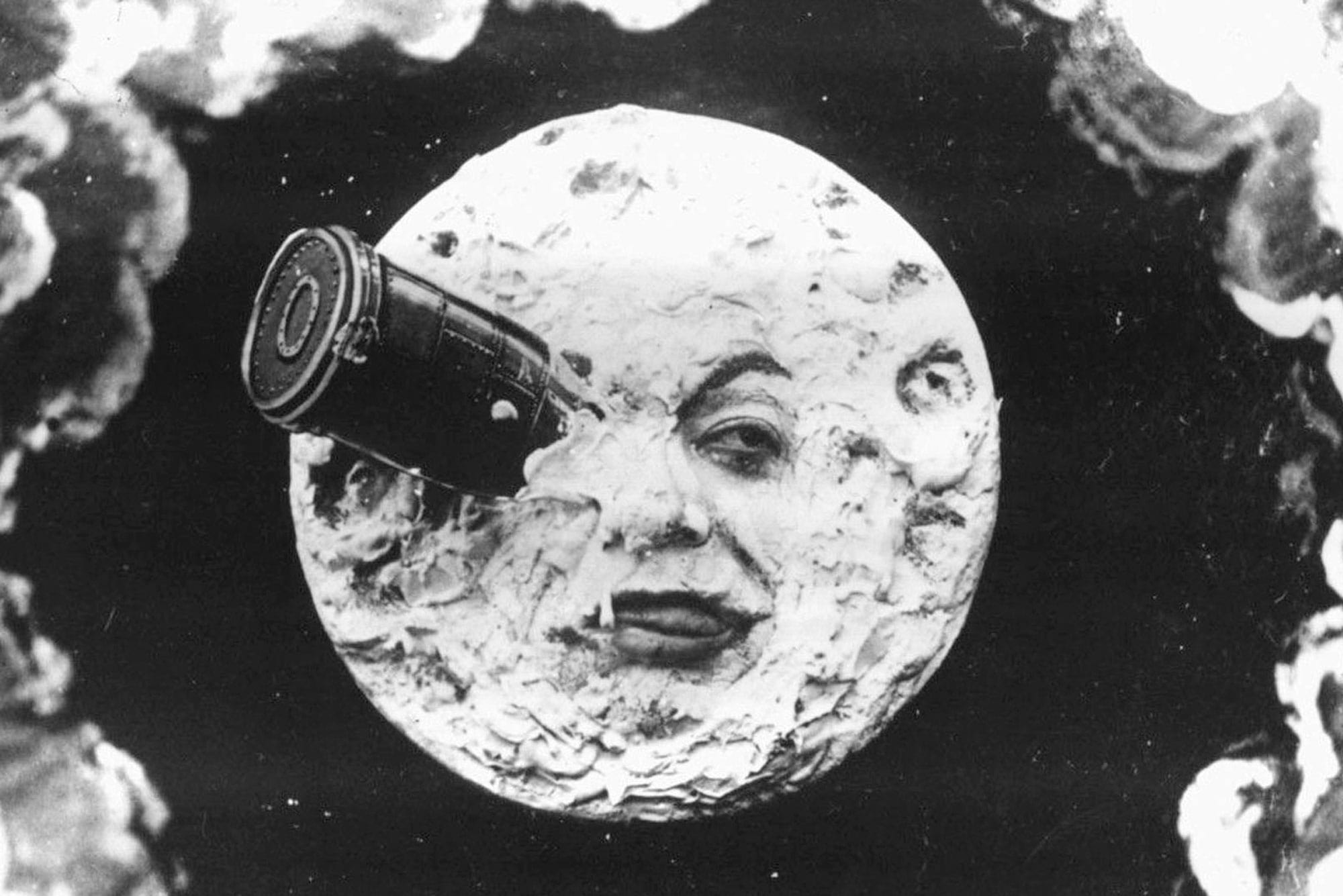
It can be said that Méliès took the first steps in special effects in cinema, using makeup, sets, and editing jumps. Many times, the magician of cinema was inspired by books by Jules Verne, which can be seen in films like “A Trip to the Moon” from 1902 and “The Impossible Voyage” from 1904.
For many, this has been the first cinematic "film" since there was a large production behind it for the time it was made.
Other people who contributed to the history of cinema were:
- León Gaumont and Alice Guy Blaché: Alice attended one of the Lumière presentations and convinced her boss (a vendor of photographic equipment) to venture into the film industry. Her boss did so, and it was Guy who was in charge of filming.
- Charles Pathé: decided to combine the cinematograph and the phonograph with the aim of capturing video and audio, but his attempt was not successful. Still, he continued in the film industry and founded the company Pathé Frères.
From Silent Film to Talking Film
“Leaving the Lumière Factory” began the history of cinema and what is now classified as silent film. Although it premiered in 1895, the golden age of films without sound or dialogue began in the 1910s and ended in the 1930s.
One of the most influential people in this cinematic era was Mack Sennett, who specialized in physical comedy. Some notable silent films were: “Sunrise” from 1927, “City Lights” from 1931, and “Sunrise,” the latter of which won an Oscar. On the other hand, the actors and actresses who stood out were:
- Alla Nazimova.
- Asta Nielsen.
- Betty Bronson.
- Brigitte Helm.
- Buster Keaton.
- Chaplin.
- Harry Lagdon.
- Oliver Hardy.
- Stan Laurel.
When silent cinema ended, talking films had already begun, the first film to feature sound effects was “Don Juan” from 1926. The film “The Jazz Singer” from 1927 is considered the first with sound, as, in addition to effects and music, the characters had dialogues.
Facts about silent and talking cinema
Something many do not know is that what lacked sound was the projection, but there was sound in the auditorium. In many screenings, live music was played that matched the film on screen. This happened in the first 30 years of cinema history, as devices were created to capture sounds.
In the early talking films, the sound quality was not very good, as viewers could hear background noise, which interfered with the enjoyment of the film. Over the years, new technologies were created, allowing us to enjoy incredible sound effects.
Modern films use technologies such as Dolby Stereo and Dolby Atmos, thanks to which we enjoy high sound quality.
The beginning of color films in cinema
Color cinema emerged gradually, with the first methods coloring each frame, which was costly and ineffective. It was in 1915 when Technicolor was created, a technology that used primary colors to add all colors to films.
With Technicolor, the film “The Vanity Fair” from 1935 was made, directed by Rouben Mamoulian. This is considered the first film where colors could be appreciated. Since its release, Technicolor began to be a common tool in films.
In the early 1950s, the company Eastman Kodak entered the film industry. This was a simpler and more efficient solution that allowed films to have color images. The companies producing the films quickly replaced Technicolor with Eastman Kodak.
Birth of the Film Industry
The center of the film industry is Hollywood; why is this neighborhood known as the Mecca of Cinema? Several factors contributed to this, the first being its climate. Sunny days prevail there, and directors from past decades took advantage of that to dedicate several hours to the filming of their movies.
The second factor was patents and Thomas Alva Edison, who invented a device in the late 19th century that displayed moving images. This was called the “Kinetoscope” and Edison patented it. When presentations with the Lumière Cinematograph began, patents entered the film world.
Edison required that all filming within the United States have a certificate issued by his office. Obviously, a significant amount of money was necessary for this. In addition to this, Thomas Alva Edison hired detectives to discover film productions that did not have the certificate.
Hollywood and the Film Industry
As Edison’s detectives focused more on Boston, New Jersey, and New York, the products filmed in Hollywood. This neighborhood had two advantages: it was far from Edison and close to Mexico, which would be a refuge for producers in case Edison discovered them.
When the film industry began to grow, the popularity of Hollywood increased significantly. This has persisted to the present day, as the neighborhood is known as the Mecca of Cinema.
Genres in Cinema
The first two cinematic genres that existed were comedy and tragedy, both of which were mixed with others that we know today. However, over time, the need arose to create individual genres that captured the attention of viewers.
The importance of film genres increased after World War II. Those that have been created and that we continue to enjoy today are the following:
- Action.
- Science fiction.
- Drama.
- Fantasy.
- Musical.
- Romantic.
- Thriller.
- Horror.
The Creation of Cinematic Language in Film
Cinema as we know it today is thanks to the implementation of elements that directors can use. Among them are: space, rhythm, sound, tone, color, movement, editing, and lighting. These factors form the cinematic language.
The main pioneers of this language were David W. Griffith and Sergei Eisenstein. Thanks to them and their works, the trend of filming each movie as if it were a play came to an end.
In cinema, special effects, animations, and other techniques have been added that have led this industry to experience a true evolution. Thanks to the work of the pioneers, we can enjoy films with the quality that characterizes them today.