AI audiovisual production
Brand narrative: why AI amplifies (not replaces) direction
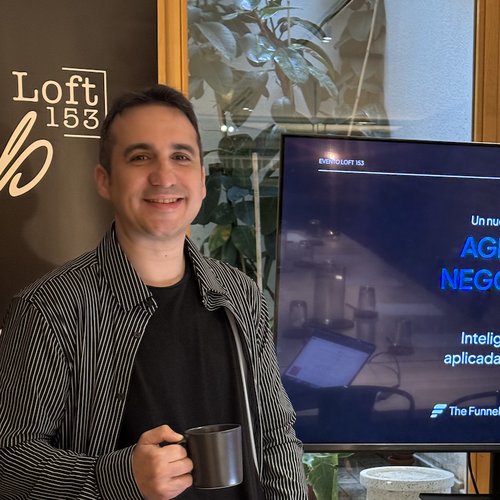
Audiovisual technician · Founder of Brainstorming Films · AI consultant
Every time a technology appears that promises to do things for us, one question is worth more than the rest: which part of the work can never be delegated?
In brand narrative, that part is direction. The decision about what a company tells, why it matters, in what tone and to whom. That decision is not made by a model. It's made by someone who understands the business, the market and the audience. And sustains it through the whole process.
This article is about why AI, far from replacing that function, makes it more important.
What brand narrative is (and what it is not)
Brand narrative is not a slogan. It's not the "About us" page. It's not a pretty story for LinkedIn.
It's the structure that connects what a company does with why it matters to do it. It's the coherence between the product, the voice, the public decisions and the apparently small details. It's what allows a person to remember a brand six months after seeing it.
A well-built brand narrative has three layers:
- A foundational truth. Something the company believes that holds up in its actions. If it doesn't hold up, it's not narrative: it's campaign.
- A way of telling it. Tone, rhythm, aesthetic decisions. Form is the proof that the truth matters.
- Continuity. The ability to sustain that narrative over time, in every piece, in every public decision. What we call world coherence in cinema.
All three layers are built through direction. Not through generation.
Why AI doesn't build narrative
AI models are extraordinarily good at one thing: generating variants of something that already exists. If you give them a pattern, they reproduce it. If you give them a reference, they version it. What they don't do is decide which pattern matters.
A company that asks a model "create a brand narrative for my business" gets what the model thinks resembles a brand narrative: coach-style phrases, generic values, a story with three predictable acts. The result is not false. It's impersonal. And impersonality is the opposite of a narrative.
Narrative is born from the decision about what to leave out. And leaving out requires craft: knowing why something is wrong even when it sounds right. That's the function of direction.
What AI does when direction is clear
If direction is built —if there's a foundational truth, a defined tone, a coherent world—, AI becomes a brutally useful tool. It accelerates what used to take weeks:
- Rapid hypothesis visualization. Before investing in a shoot, several aesthetic directions can be tested in hours, not weeks.
- Production of images that illustrate a narrative universe. When the brand lives in symbolic or emotional territory, models generate pieces that would be impossible or very expensive to film.
- Iteration over existing pieces. Variants for different channels, duration adaptations, language versions. All under the same direction.
- Freeing the creative team from mechanical tasks. More time on decisions, less time on production.
In all those cases, AI doesn't replace anyone. It amplifies the work of direction.
The right question before talking about tools
When a company consults us about an AI audiovisual piece, the first question isn't technical. It's strategic: what decision do you want to move in whom?
If the answer is vague —"we want to position the brand", "we want to communicate our values", "we want something different"—, the tool doesn't matter. No model, no team, no production company will produce anything good without a clear answer to that question.
If the answer is concrete —"we want an operations director at an industrial company to understand we're their supplier in three minutes", or "we want the internal team to feel part of the transformation we're going through"—, then we can start thinking about how to tell it.
Direction starts there. In turning a diffuse intention into a clear decision.
The four pillars of a narrative that holds up
A brand narrative survives time when it rests on four decisions made at the beginning and not changed on the first impulse:
1. A truth the company can defend
If the narrative says "we believe in doing things with time" but internal processes are built to deliver everything in 24 hours, the narrative collapses. The audience notices. They notice fast.
The foundational truth is not what the company wants to be. It's what the company already is, articulated with clarity.
2. A tone that's recognizable without a signature
If your brand can write a communication and a loyal client recognizes it before seeing the logo, you have tone. If not, you have texts. Tone is built in repeated decisions: sentence structure, forbidden words, preferred words, what's avoided on principle.
3. A coherent visual world
Brands with good narrative have an aesthetic universe that holds in every piece. Not a rigid template: a sensibility. A code of light, a color range, a way of looking. When you produce with AI, this pillar becomes critical, because the tool tends to inconsistency without fixed art direction.
4. An emotional core
Every lasting narrative touches a nerve: a fear, a desire, a recognizable discomfort. It doesn't sell; it resonates. AI can help you test forms, but the nerve is identified by a human who understands who they're talking to.
AI's role within the flow
In our process, AI appears in the fifth step of seven. Before there's strategy, concept, script and storyboard. After comes professional editing and delivery adapted to final use. That is: the tool arrives when all the foundational decisions are already made.
That order is not bureaucratic. It's the only way for the result to have coherence. If AI appears earlier —if a company starts by "let's see what the model comes up with"—, narrative is built backwards from the output. And the output rarely has enough personality to hold up a brand.
A concrete example
A recent editorial project illustrates this well. The strategy started from a clear profile: a retired person with a life story that deserved to be told. We defined an emotional approach centered on memory, legacy and the need to give form to that experience. The concept was built as an intimate narrative: a person in a quiet environment, away from the noise, who connects with their past and finds in writing a way to express it.
The script was structured through everyday moments —routine, silence, photographs, memories—. The storyboard fixed the atmosphere: warm tones, natural light, elements like fire to generate closeness. Only then did AI come in, generating scenes that respect that direction: quiet environments, warm palette, visual coherence in every shot. And editing in DaVinci Resolve built the rhythm and final emotion.
The piece doesn't look "AI-made". It looks like a story with weight. The difference wasn't made by the tool: it was made by direction.
When to be wary of a brand narrative with AI proposal
If an agency or production company proposes a brand narrative process with AI and you can't identify who directs, in which steps a human intervenes and when the foundational decisions are made, be wary.
Clear signals the process isn't well planned:
- They jump straight to "we'll generate some pieces to see options" without going through strategy.
- They talk about prompts before objectives.
- They show their visual style catalog as if the choice were aesthetic and not strategic.
- They don't have a script before the storyboard, or storyboard before generating.
- The "it's good" criterion seems to be "it looks nice", not "it communicates what it has to communicate".
Closing
Brand narrative is not an asset that gets downloaded. It's a decision that's sustained. Artificial intelligence changes how that decision gets executed, not who makes it. When you understand that role division, AI becomes an extraordinary tool. When you confuse the roles, the result is content without a center.
If you're interested in how we apply this thinking to concrete pieces, you can see the Brainstorming Films Method applied to the service, or read about the most frequent brand storytelling mistakes with AI For the broader picture, visit Brainstorming Films, the AI audiovisual production studio.
Artificial intelligence doesn't replace the eye. It amplifies it.
About the author
Audiovisual technician · Founder of Brainstorming Films · AI consultant
Directs AI-powered audiovisual production for B2B brands. After years in traditional production, he founded Brainstorming Films as an AI-native studio: human direction and scriptwriting, modern-tool execution.
More about Gonzalo →